
Stand-Up Pouches (Doypack): Types, Materials & Selection

A stand-up pouch is a flexible package with a gusseted base that opens out to support the filled bag on a flat surface. Often called a Doypack, it combines a printable front panel with a compact, flexible body. Choose the material and closure to suit the product, filling process and barrier requirements.
This guide compares five common formats and explains what to specify before ordering custom stand-up pouches for food, beverages or household refills.
What makes a stand-up pouch stand upright?
The folded bottom gusset expands as the pouch is filled, creating a base. Stability depends on the base design, pouch dimensions, film stiffness, fill level and weight distribution. Opening the top does not remove the base, but an empty or partly used pouch will not necessarily stand as securely as a correctly filled one.
Stand-up pouches are used for products such as snacks, coffee, pet food, sauces and refill liquids. A bag that works well for dry granules may need a different material structure, seal design and closure to hold a liquid.
THIMONNIER’s history credits Louis Doyen with the invention in 1963. DOYPACK® is a THIMONNIER trademark; “stand-up pouch” is the general packaging term used throughout this guide.
Five common stand-up pouch formats
These five common formats can share features. A shaped pouch can also have a spout, while a conventional gusseted pouch can include a zipper.
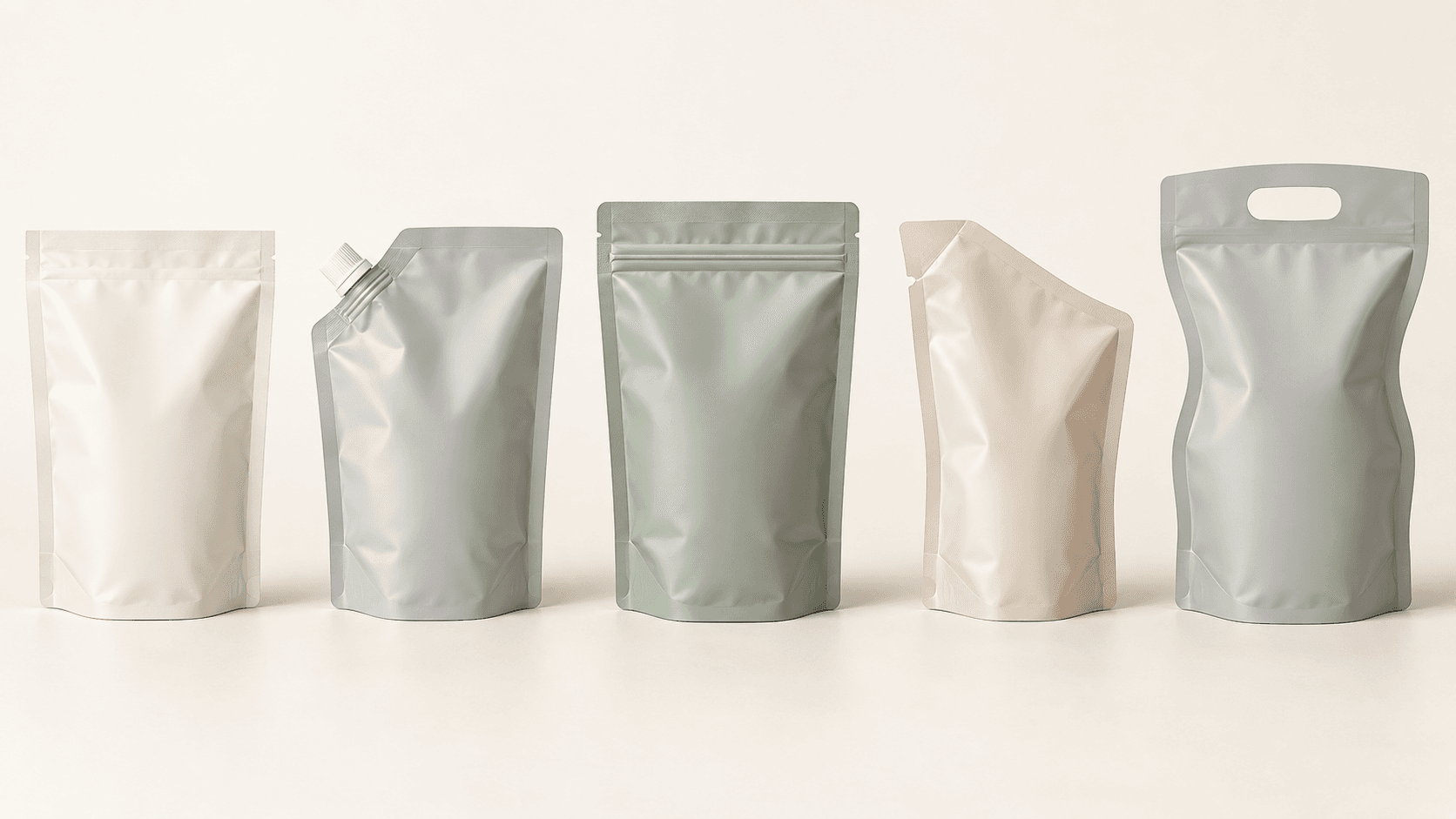
1. Plain heat-sealed stand-up pouch
A plain pouch has no built-in reclosure. It is filled and heat-sealed, then opened by tearing or cutting the top. This is a straightforward option when the product will be consumed at once or when repeated opening is not required.
Confirm the filling opening, final seal area and tear-notch position, and decide whether consumers will need scissors. A tear notch helps opening; it does not make the pack resealable.
2. Spouted stand-up pouch
A spouted pouch combines a flexible bag with a fitment and cap. It can support controlled pouring, dispensing and repeated closing for products such as sauces, beverages or detergent refills, provided the complete package is suitable for the contents.
Specify the spout position and bore, cap type, product viscosity and filling-machine interface. Allow for headspace and usable volume. Choose the spout angle for the filling line, then confirm fitment sealing, leakage and transport performance with the intended product and pack size.
3. Zipper stand-up pouch
A zipper allows the bag to be opened and closed again. It is commonly used for dry products such as snacks, coffee, powders and pet food. Many retail packs also have a heat seal above the zipper that the consumer removes on first opening.
Check the zipper’s performance and opening force, along with the initial heat seal. An ordinary zipper should not be assumed to be liquid-tight or to restore the original unopened-pack barrier after use. Liquid or high-demand applications need a closure specifically designed and validated for that use.
4. Integral pouring-corner pouch
The bag’s outline can form a narrow pouring or dispensing corner without adding a rigid plastic spout. This can be useful for single-use liquid or gel portions when a controlled opening is needed.
Test the opening direction, tear control and dispensing behavior. Once torn open, this format normally cannot be resealed unless a separate reclosure feature has been designed into it.
5. Shaped stand-up pouch
Shaped pouches use contours, a waist or a handle to create a distinctive silhouette or improve handling. A shape can be combined with a suitable zipper or spout.
Review the base stability, grip, usable capacity, seal width and stress around corners or handle cut-outs. Test the proposed shape through filling, packing and transport before approving it.
What materials are stand-up pouches made from?
A stand-up pouch is a bag format, not a fixed PET/foil/PET/PE recipe. Its layers are selected to provide print quality, mechanical strength, barrier protection and a compatible sealing surface. The number of layers alone does not tell you whether the package will protect the product.
Printed outer layer: supports artwork, handling and the required surface finish. PET is one possible outer film, but other film families may be used.
Barrier function: foil, metallized films, coatings or barrier polymers may be considered when oxygen, moisture, light or aroma transmission matters.
Inner sealing layer: must suit the product, sealing conditions and any spout or zipper attachment. PE or PP-based sealants are examples; the choice depends on the application.
Bonding and process compatibility: the full construction, including adhesives where used, must be suitable for filling, storage and any heat treatment.
For an oxygen-sensitive product, discuss the required oxygen transmission rate (OTR). For a moisture-sensitive product, discuss water vapor transmission rate (WVTR). Compare test results only with the stated test method, temperature and humidity. Barrier-film data alone does not establish the shelf life of a finished, filled pouch.
PE- or PP-based mono-material pouch designs also exist. “Mono-material” does not automatically mean accepted for recycling everywhere: the complete pack, including closures, barrier layers, inks and adhesives, must be assessed against the relevant collection and recycling system. RecyClass design-for-recycling guidance is one reference for European plastic packaging.
Bottom gussets, zippers and spouts: details that affect performance
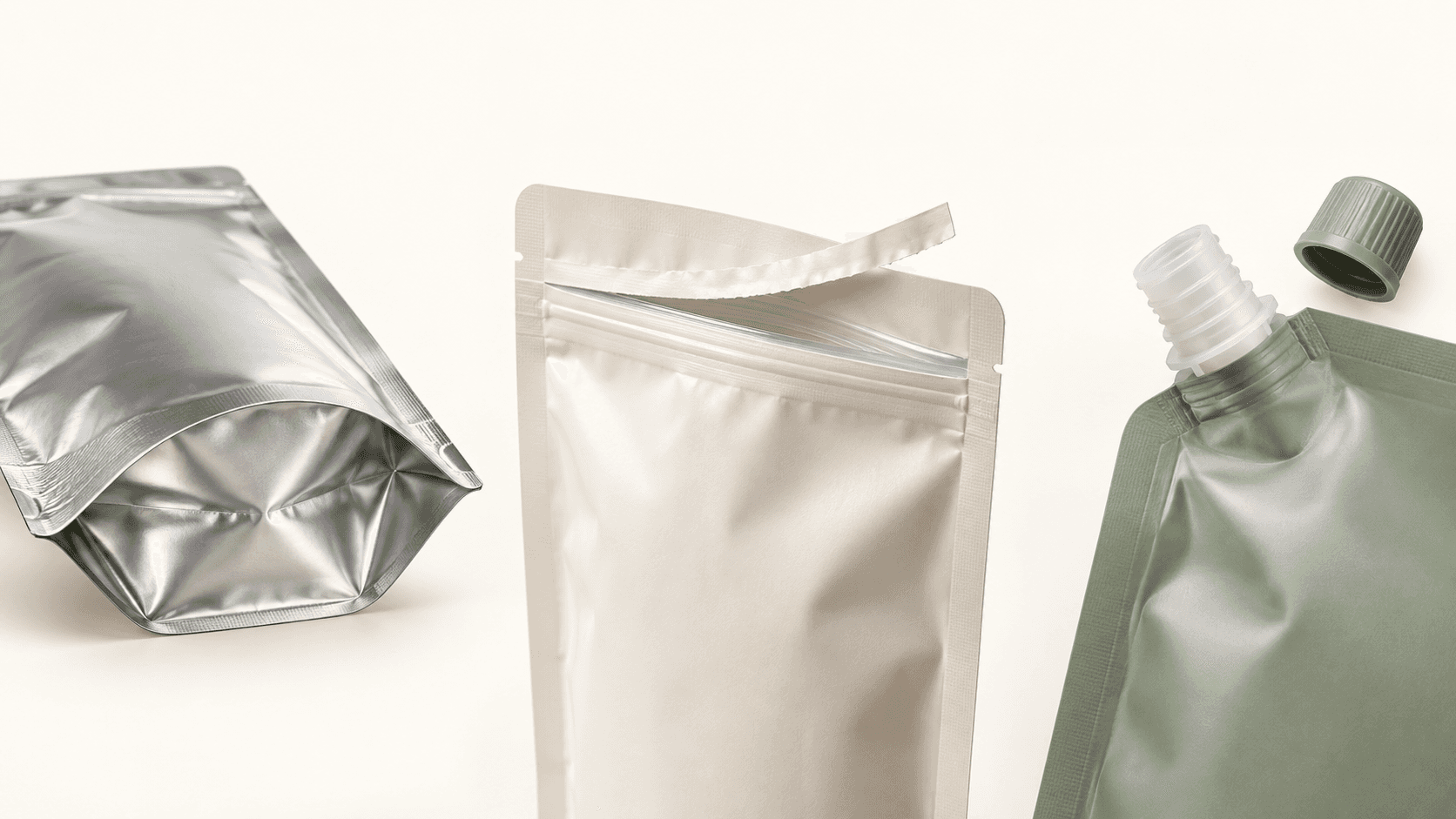
The bottom gusset influences how the bag stands and how much space it takes on a shelf. The closure affects filling, opening and repeated use. Neither feature should be specified in isolation from the film and contents.
For example, a spout may reduce the usable filling space or change the way liquid moves during a drop. A handle may make carrying easier but also concentrate force around its cut-out. Review these details with a physical sample and a filled-pack trial before approving the final artwork and tooling.
Benefits and trade-offs compared with rigid packaging
Stand-up pouches offer a broad printing surface and can reduce the space occupied by empty packaging. Zippers and spouts can add convenience. Depending on the product and supply chain, a flexible format may also reduce packaging weight or logistics cost.
Those benefits are not automatic. Compare the full system: material use, filling equipment, packing speed, secondary packaging, damage risk, product protection and end-of-life options. A stand-up pouch is not inherently better insulated, guaranteed to cool faster or always cheaper than a bottle or can.
Hot-fill, retort and frozen applications require constructions developed and validated for their specific processing and storage conditions. A standard ambient-use pouch should not be substituted on appearance alone.
What to specify before requesting a quotation
A useful enquiry starts with the product and the way the pouch will be used. Send the following information, or identify what is still undecided:
Contents: product type, liquid or solid form, viscosity where relevant, and target shelf life.
Filling and storage: filling temperature, any heat treatment, chilled or frozen conditions, and filling-machine details.
Size and capacity: target fill weight or volume, proposed width, height and bottom gusset, or a reference sample. Film dimensions do not by themselves guarantee usable capacity.
Closure: plain seal, zipper, spout or another opening system, including any repeated-use requirement.
Protection: oxygen, moisture, light, aroma, puncture or chemical-compatibility requirements.
Appearance: artwork, printing colors, finish, window requirements and barcode placement.
Order and delivery: quantity, number of designs, destination and requested schedule.
Validation: agreed sample approval, filling trials, inspection methods and acceptance criteria. Depending on the application, checks may include seal strength, leakage, drop performance, dimensions and closure function.
For food-contact or other regulated applications, identify the target market and ask which supporting documents and tests apply to the intended use. Do not treat a generic material name as proof of suitability.
Frequently asked questions
Is Doypack the same as a stand-up pouch?
Doypack is commonly used when discussing stand-up pouches, but DOYPACK® is a THIMONNIER trademark. “Stand-up pouch” describes the general gusseted flexible-packaging format.
Can a stand-up pouch hold liquids?
Yes, when the film, seals and closure are designed for the product and filling process. Spouted pouches are one option. A standard zipper pouch should not be assumed to provide a liquid-tight reclosure.
Does every stand-up pouch need aluminum foil?
No. Foil is one barrier option, not a defining feature of the format. Material selection depends on product sensitivity, shelf life, processing conditions and other performance requirements.
Can a pouch extend product shelf life?
An appropriate package can help protect the product from relevant exposure, but shelf life depends on the product, processing, filling, seals, barrier performance and storage conditions. It must be established for the complete product-and-package system.
Are stand-up pouches recyclable?
Some designs are developed for particular recycling streams. Acceptance depends on the full construction and the local collection and recycling system. Confirm the intended market before making a recyclability claim.
Discuss a custom stand-up pouch with HUAYN
Send your product details, target fill weight or volume, proposed dimensions or a sample, closure preference, artwork and order quantity. HUAYN can review the packaging design and production requirements with you; the material, tests, minimum order quantity and lead time are confirmed for the project.
Explore our bag types and material guide, review artwork and prepress preparation, or see our flexible packaging printing service. Contact HUAYN to discuss your pouch project.