
Spout Pouches: Liquid Packaging, Uses & Comparisons

Choosing spout pouches for your product
Spout pouches combine a flexible pouch with a rigid spout and cap for liquid foods, sauces and household refills. The fitment can sit at the top or a corner, with its position chosen for filling, grip and pouring. The pouch can have a standing base or a shaped outline.
Spout pouch specifications
Parameter | Specification |
|---|---|
Pouch and spout position | Standing base or shaped outline, with a top or corner spout. |
Material structure | PET/NY/PE is an available pouch-body laminate for compatible filling conditions. Retort applications require a retort-grade sealant, laminate, spout and cap system; a standard PE-sealant pouch is not a retort specification. |
Spout internal diameter | 8.6, 9.6 or 16 mm. These are the internal flow-opening diameters of the spout. |
Cap and filling interface | The neck and cap match the selected spout. Nozzle and filling-interface dimensions follow the machine route, through the spout or an open pouch edge. |
Usable volume | The intended fill volume is based on the formed pouch, including gusset expansion, fitment position and filling headspace. |
Product and filling process | Viscosity, particles and filling temperature guide the dispensing design. The film, fitment and seals are chosen for the formulation and its food-contact or household-use requirements. |
Gravure printing MOQ | 6,000 linear metres of printed film, measured along the roll. Bag quantity is calculated from the print repeat, bags per repeat and conversion allowance. |
Quotation | Itemized quotation within 24 business hours. |
Specify your spout pouch and request a quote
Structure and filled-pack checks
A rigid fitment joins the flexible pouch at the top or a corner. Set the spout position for filling, grip and pouring, with a standing base or shaped outline where needed.

Construction details
Use the details below to review the drawing, filling process and filled sample.
1. Spout and cap

Confirm neck, cap and dispensing needs. Spout position, opening size and cap design need to suit the product and the consumer. Review viscosity and any particles with representative filling and dispensing trials.
2. Spout-to-film joint
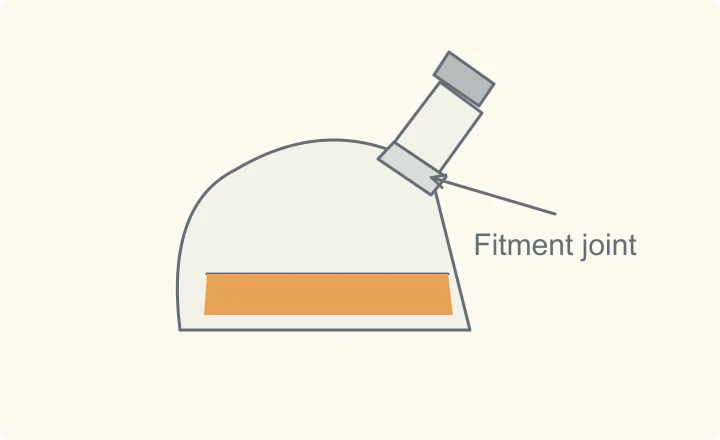
Review the welded fitment area. The fitment joint and the pouch seals are separate areas to check. Confirm the film, fitment and sealing process together, including the actual filling conditions.
3. Fill level and headspace

Check the intended filling route. Confirm whether the product is filled through the spout or an open pouch edge. Agree headspace, closure steps and leak checks with the filling process.
Common applications
Sauces, purées and other viscous products
Choose the bore and flow path for viscosity, particles and portion size, and match the neck to the filling equipment. Check comfortable emptying and product retention around the neck.
Beverages and food refills
Set the opening force, pouring control and reclosure leakage requirements. For young children’s products, specify the cap design and applicable market safety requirements with a specialist.
Home and personal-care refills
For detergent and personal-care products, choose the film, fitment and seals for chemical compatibility, fragrance retention and handling, using the actual formulation for the review.
Hot-filled or heat-treated applications
Specify the pouch and fitment system for hot filling or retort, using the heating, pressure and cooling conditions for that process.
Advantages
Controlled access
A suitable neck and cap can improve pouring and reduce the need to cut a large opening.
Repeated closing
A compatible cap can support several uses. Check opening and reclosing with the intended consumer and product.
Flexible empty packaging
The pouch body can reduce empty storage volume compared with rigid formats, although fitments and filling logistics must be included in the comparison.
Practical considerations
Additional components
Fitments, caps and their attachment introduce cost and inspection requirements.
More demanding line compatibility
Filling through the spout and filling through an open pouch top require different handling. Confirm the actual supply configuration.
Product evacuation and leakage
Corners, neck geometry and viscosity affect residual product. Drop, compression and reclosure tests should use filled packs.
Compare bag types
Compared with stand-up pouches
Zipper stand-up pouches are usually more convenient for dry snacks eaten directly or scooped from the pack. Spout pouches suit pourable products. Both formats offer standing bases. Read the stand-up pouches guide.
Compared with three-side-seal bags
A tear-open flat sachet can serve a single-use sauce or sample without a cap. A spout is worth considering when repeated closing or controlled dispensing justifies the added component. Read the three-side-seal bags guide.
Compared with custom-shaped pouches
A contoured pouch can improve grip or recognition and can also include a spout. Judge the outline and dispensing feature independently before combining them. Read the custom-shaped pouches guide.
Specifications for your quote
Provide the specifications you know and mark any open items as "to confirm".
Specification | What to provide or verify |
|---|---|
Fitment and cap | State position, bore, cap type, opening requirements and filling-machine interface. |
Contents and process | Provide viscosity, particles, formulation compatibility needs, filling conditions and any heat treatment. |
Product and protection | State contents, target fill, storage and distribution. Identify barrier, puncture, chemical or thermal requirements that need verification. |
Material and thickness | Choose the material structure and thickness for the application and agreed trials. |
Artwork and quantity | Provide print files or artwork status, finish, quantity per design and size, destination and required schedule. |
Sampling and documentation | Agree sample type, machine or filling trials, acceptance criteria and relevant supporting documents before order approval. |
Questions before ordering
What specification does a retort spout pouch need?
Retort applications use a film, adhesive, seal, fitment and cap system specified for the product and thermal process.
Should the pouch be filled through the spout or the top?
Use the arrangement supported by the intended line and supply format. Confirm it before tooling and ordering.
What makes a spout pouch leak-resistant?
Leak resistance comes from the fitment seal, cap engagement and complete pouch construction. Set these together and check the filled pack after handling and processing.
What are the MOQ, sample lead time and production schedule?
For gravure-printed packaging, the MOQ is 6,000 linear metres of printed film. Normal production takes 15 working days for a first order and 10 working days for a repeat order, counted from signing the formal contract. Shipping time is additional. Send your material, dimensions, quantity per design and artwork status so we can confirm the sample plan.
What evidence should be agreed before approval?
Confirm the specification, sample approval, relevant trial results and acceptance criteria. For regulated applications, identify the market, intended use, document issuer and scope.
Prepare your packaging request
Send the product, target fill, storage or shipping conditions, filling method, quantity per design and destination. Include a sample or drawing if available. Configure spout pouches and request a quote.
Compare all packaging types · Food packaging material guide · Procurement checklist