
Bags on a Roll: Uses, Perforations & Sizing

Choosing perforated bags on a roll for your product
Bags on a roll are finished bags connected by perforations for tear-off dispensing at a packing station. The bags can be flat, gusseted or another agreed format. Match the roll dimensions to the dispenser and position the tear line clear of the product compartment for clean separation of each empty bag.
Perforated bags on a roll specifications
Parameter | Specification |
|---|---|
Bag size | Finished width and length are measured between the side edges and tear-off perforations; gussets are specified separately. |
Perforation | The specification defines the tear-off line and the connection needed to hold the roll together during handling. |
Roll configuration | Bags per roll, core dimensions, roll outer diameter and winding direction match the dispenser or packing station. |
Film | Material, colour and one-wall thickness follow the contents and handling load. |
Order quantity | Unprinted rolls are quoted by bag size and roll configuration. Gravure-printed film uses a 6,000 linear metre starting MOQ. |
Quotation | Itemized quotation within 24 business hours. |
Configure bags on a roll for your dispenser
Structure and filled-pack checks
Flat, gusseted and other agreed bag formats are connected by perforations and wound into rolls. Set the tear line for clean separation and the roll dimensions for the dispenser.

Construction details
Use the details below to review the drawing, filling process and filled sample.
1. Tear perforation
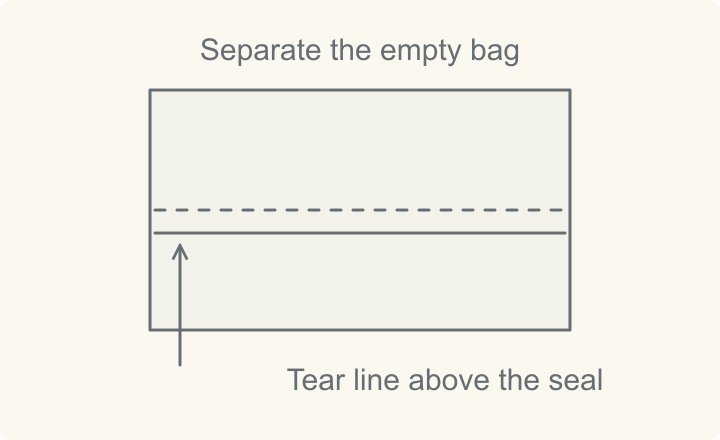
Separate each empty bag before use. Position the perforation clear of the product compartment and set the tear force for clean dispensing.
2. Roll and dispenser

Match the core or coreless format, roll diameter, bag count and dispensing direction to the holder.
3. Bag opening and base

Identify the opening edge, bottom seal and side gussets on the sample. Select film and handling requirements for the contents.
Common applications
Fresh-produce handling
A roll can keep bags available at a repetitive packing point. Specify the bag size, opening ease and any need for ventilation or moisture control. Food-contact suitability and product shelf life require separate assessment.
Routine lining
Roll-supplied liners make bags easy to dispense one at a time. Set the liner size for the container and load, then specify bags per roll.
Retail or workbench packing
Connected bags can reduce loose-pack handling at a station. Test separation with the actual dispenser, operator and product, including whether two hands are available.
Advantages
Organized supply
A compact roll holds a known series of bags for repeated use.
Convenient separation
A suitable perforation pattern can make each bag accessible without scissors.
Adaptable bag construction
Roll supply can be considered separately from material, gusset or closure choices.
Practical considerations
Perforation balance
Balance the perforation so the roll stays connected during handling and each bag tears off cleanly during dispensing.
Roll compatibility
Core, outer diameter, width and winding tension affect dispenser fit and handling.
Closing the filled bag
The perforation provides separation. Add a suitable closing method for the filled bag and required product protection.
Compare bag types
Compared with printed rollstock film
Finished bags on a roll are separated and used. Rollstock is film intended for forming, filling and sealing equipment. Ordering the wrong one changes the entire production workflow. Read the printed rollstock film guide.
Compared with square-bottom liner bags
Liner describes the bag’s job inside a container; roll supply describes dispensing. Liners are also supplied on rolls where this suits packing and handling. Read the square-bottom liner bags guide.
Compared with three-side-seal bags
Loose pre-made pouches suit individual loading and controlled presentation. Roll dispensing suits repetitive packing with a compatible holder. Read the three-side-seal bags guide.
Specifications for your quote
Provide the specifications you know and mark any open items as "to confirm".
Specification | What to provide or verify |
|---|---|
Individual bag | State finished width and length, gusset if any, seal position, opening and intended closure. |
Roll and tear line | State bags per roll, core and maximum outer diameter, roll width, winding direction and perforation requirements. |
Product and protection | State contents, target fill, storage and distribution. Identify barrier, puncture, chemical or thermal requirements that need verification. |
Material and thickness | Choose the material structure and thickness for the application and agreed trials. |
Artwork and quantity | Provide print files or artwork status, finish, quantity per design and size, destination and required schedule. |
Sampling and documentation | Agree sample type, machine or filling trials, acceptance criteria and relevant supporting documents before order approval. |
Questions before ordering
How do roll bags and form-fill-seal film differ?
Bags on a roll are finished bags ready to separate and fill. Form-fill-seal rollstock is converted into bags by the packing machine.
Which roll dimensions should I specify?
Specify bag dimensions, film, bags per roll, core and maximum roll diameter to match the dispenser.
How should the perforation tear?
Use a balanced perforation: firm enough for roll handling and easy to separate cleanly in the intended dispenser.
What are the MOQ, sample lead time and production schedule?
For gravure-printed packaging, the MOQ is 6,000 linear metres of printed film. Normal production takes 15 working days for a first order and 10 working days for a repeat order, counted from signing the formal contract. Shipping time is additional. Send your material, dimensions, quantity per design and artwork status so we can confirm the sample plan. For unprinted bags, confirm the MOQ and production schedule with the material and dimensions.
What evidence should be agreed before approval?
Confirm the specification, sample approval, relevant trial results and acceptance criteria. For regulated applications, identify the market, intended use, document issuer and scope.
Prepare your packaging request
Send the product, target fill, storage or shipping conditions, filling method, quantity per design and destination. Include a sample or drawing if available. Configure perforated bags on a roll and request a quote.
Compare all packaging types · Food packaging material guide · Procurement checklist