
Courier and Mailing Bags: Uses, Closures & Sizing

Choosing courier and mailing bags for your product
Courier and mailing bags are flexible envelopes for apparel, textiles and other non-fragile goods. They provide shipping containment, privacy and surface protection, usually with an adhesive flap for closing. Specify the body dimensions separately from the flap, and allow room for the contents. Crush-sensitive goods need a carton or cushioning.
Courier and mailing bag specifications
Parameter | Specification |
|---|---|
Finished size | Usable internal width and height are stated separately from the adhesive closing flap. |
Closure | A self-seal strip closes the bag. A second adhesive strip can support a return journey. |
Film and printing | The film specification identifies thickness through one wall, colour, opacity and printed design. |
Handling | Product dimensions, packed weight and transport handling guide the film and seal specification. |
Order quantity | Unprinted mailers are quoted by size, film specification and quantity. Gravure-printed film uses a 6,000 linear metre starting MOQ. |
Quotation | Itemized quotation within 24 business hours. |
Set up your mailing bag request
Structure and filled-pack checks
A flexible envelope usually closes with an adhesive flap. Finished body dimensions and flap size should be specified separately. The sealed body, adhesive bond, tear opening and any return strip each affect how the pack performs during delivery and use.

Construction details
Use the details below to review the drawing, filling process and filled sample.
1. Peel-and-seal flap
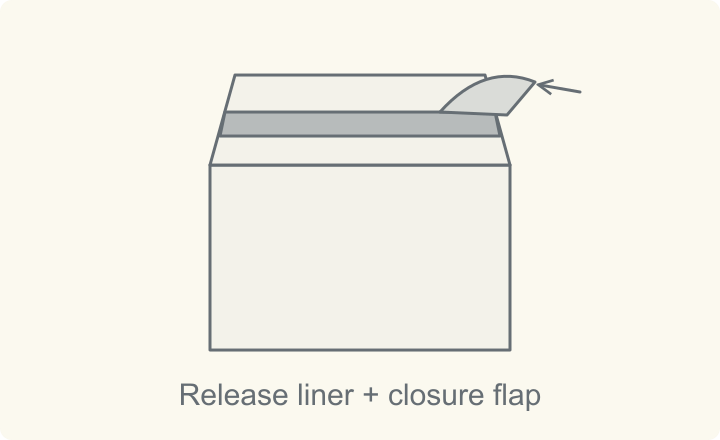
Confirm the flap and closure strip. Check the release liner, adhesive location and usable flap length. Review the closing method on a filled sample rather than treating the flap as extra product space.
2. Usable packing space

Allow for the packed product thickness. Measure a representative packed item, including any inner protection. Product depth and the closure allowance affect the useful size of a flat mailer.
3. Transit protection

Check the complete shipping pack, including the flap closure, puncture resistance and inner protection for the journey. Use a specified food-contact inner pouch for food products.
Common applications
Apparel and soft goods
Flexible mailers can follow the shape of folded goods and occupy less unused volume than an oversized box. Check packing access and avoid overstretching the seam around bulky corners.
E-commerce fulfilment
The bag can provide an exterior for shipping labels and order identification. Confirm label adhesion on the actual surface and test scanner readability after handling. A printed design should leave an appropriate label area.
Return-enabled orders
A separate return strip provides a second closure for return shipping. Set the first opening path to leave enough bag material for the second seal, then check the complete opening and return sequence.
Advantages
Flexible fit
A suitable bag can conform to soft contents without requiring a fixed rigid shape.
Convenient closure
An adhesive flap can support a straightforward packing operation when the surface and conditions are suitable.
Privacy and branding choices
Opacity and printing can be selected for the shipping brief, with material and recyclability considerations assessed separately.
Practical considerations
Protection for sensitive contents
Use a box, cushioning or other protective packaging around fragile, sharp and easily deformed goods.
Adhesive sensitivity
Dust, moisture, temperature, storage and closure pressure can influence the bond. Evaluate the actual packing and distribution conditions.
Water resistance and opening security
Specify water resistance and opening security through the film, seams and flap construction, using the agreed test requirements.
Compare bag types
Compared with three-side-seal bags
Three-side-seal pouches suit product containment and final heat sealing. Courier mailers use an adhesive flap for shipping. Read the three-side-seal bags guide.
Compared with square-bottom liner bags
A liner protects contents inside a container; a mailer forms the shipping outer. Use a carton and suitable inner protection for fragile goods. Read the square-bottom liner bags guide.
Compared with perforated bags on a roll
Roll-supplied mailers suit repetitive packing. Specify the flap closure and automation requirements alongside roll dispensing. Read the perforated bags on a roll guide.
Specifications for your quote
Provide the specifications you know and mark any open items as "to confirm".
Specification | What to provide or verify |
|---|---|
Body and flap | Provide finished body width and height, flap size separately, packed dimensions and weight. |
Closure and distribution | State single-use or return closure, opening method, opacity, label area and handling conditions. |
Product and protection | State contents, target fill, storage and distribution. Identify barrier, puncture, chemical or thermal requirements that need verification. |
Material and thickness | Choose the material structure and thickness for the application and agreed trials. |
Artwork and quantity | Provide print files or artwork status, finish, quantity per design and size, destination and required schedule. |
Sampling and documentation | Agree sample type, machine or filling trials, acceptance criteria and relevant supporting documents before order approval. |
Questions before ordering
Which products suit a mailer or a shipping box?
Mailers suit apparel and other non-fragile goods. For fragile or sharp products, use a box, cushioning or a protective inner pack.
How does a return-ready mailing bag work?
A return-ready bag combines a planned first-opening path, enough remaining bag material and a second adhesive strip for the return shipment.
How do I choose mailer film thickness?
Choose thickness alongside film strength, puncture resistance, closure and the distribution brief.
What are the MOQ, sample lead time and production schedule?
For gravure-printed packaging, the MOQ is 6,000 linear metres of printed film. Normal production takes 15 working days for a first order and 10 working days for a repeat order, counted from signing the formal contract. Shipping time is additional. Send your material, dimensions, quantity per design and artwork status so we can confirm the sample plan. For unprinted bags, confirm the MOQ and production schedule with the material and dimensions.
What evidence should be agreed before approval?
Confirm the specification, sample approval, relevant trial results and acceptance criteria. For regulated applications, identify the market, intended use, document issuer and scope.
Prepare your packaging request
Send the product, target fill, storage or shipping conditions, filling method, quantity per design and destination. Include a sample or drawing if available. Configure courier and mailing bags and request a quote.
Compare all packaging types · Food packaging material guide · Procurement checklist